I want a soft, warm pretzel right now, and I have everything except the patience to roll twenty individual knots. That’s the thought that hit me at 3 PM on a rainy Saturday, staring into my pantry like it owed me something. A bag of bread flour. A jar of barley malt syrup from that one time I swore I’d make bagels. And there, at the back of the fridge, a half-used packet of yeast that was definitely still alive. I didn’t want a snack. I wanted the whole experience—the glossy, salted crust, the impossibly chewy interior, that first bite where the salt hits your tongue before the dough gives way. But I also wanted to sit down and watch the game with both hands free, not hover over a baking sheet rotating pretzels every eight minutes.
That’s when the bundt pan caught my eye. The one that usually only sees action around Easter and Thanksgiving. And honestly, it felt like a small revelation. Why shape individual pretzels when you can bake the whole glorious mass into one showstopping ring? Every slice would have that same deep brown, boiled-then-baked crust. Every piece would tear apart with that perfect pull. And the center—that soft, steamy middle—would be the exact thing you dip into a sharp, grainy mustard. So I went for it. I scaled up my standard pretzel dough, brought a pot of water and baking soda to a rolling boil, and poured the whole experiment into a well-buttered Bundt pan. An hour later, I had the most dangerously snackable loaf I’ve ever pulled out of an oven.
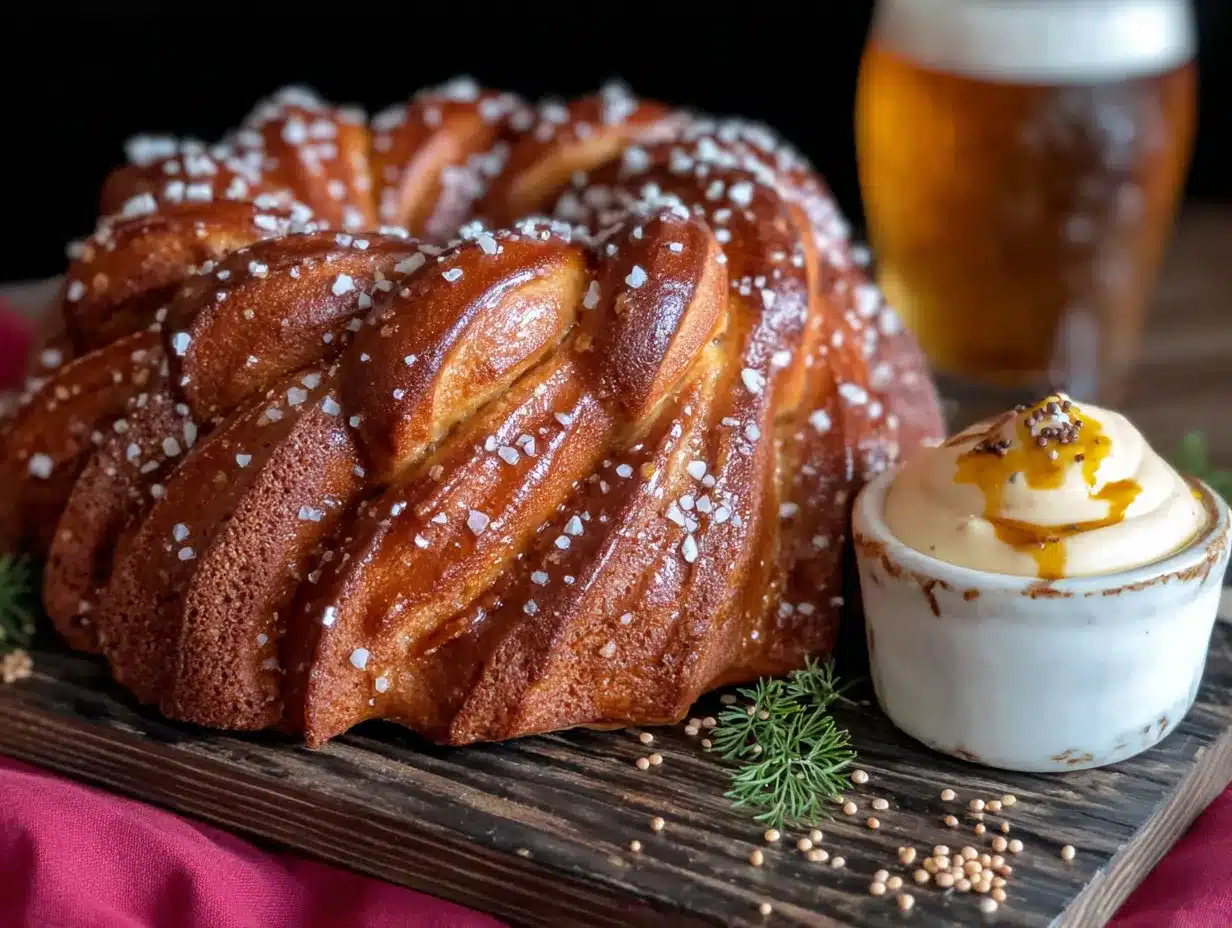
This Classic Oktoberfest Soft Pretzel Bundt with Bavarian Mustard Sauce is what happens when you stop following the rules and start following your cravings. It’s Oktoberfest in a pan, minus the lederhosen and the tent. And honestly? It might be the best decision I’ve made all season.
Why You’ll Love This Recipe
Let me tell you why this recipe has earned a permanent spot in my fall rotation. I’ve tested it five times now, tweaking the water temperature, the boiling time, the amount of salt on top. Each batch confirmed what I suspected from that first rainy afternoon: this is foolproof comfort food with serious wow-factor.
- One Pan, No Rolling: You get all the texture and flavor of traditional soft pretzels without shaping individual knots. Just pour the dough into a bundt pan and let the oven do the work.
- Authentic Pretzel Flavor: The key is boiling the dough in a baking soda bath before baking—that’s what gives pretzels their signature dark, chewy crust. No shortcuts here, just real technique that delivers real results.
- Perfect for Entertaining: This makes a stunning centerpiece for game day, Oktoberfest parties, or casual get-togethers. Everyone tears off a piece, dips it in mustard, and goes back for more.
- Make-Ahead Friendly: You can prepare the dough ahead, boil and bake the bundt, then reheat it right before serving. It tastes just as incredible on day two, especially if you warm it in the oven.
- That Mustard Sauce: The creamy, tangy Bavarian mustard dip is ridiculously easy to make and completely addictive. You’ll want to put it on everything.
I’ve made this for a small Oktoberfest gathering, for a Sunday football crowd, and just for myself on a quiet afternoon. It disappears every single time. There’s something about tearing warm, salted bread from a shared center that makes people happy. And when they dip it into that mustard sauce and their eyes go wide? That’s the moment.
What Ingredients You Will Need
This recipe uses straightforward ingredients, most of which you probably already have in your kitchen. The magic happens in the technique, not in obscure specialty items. Here’s what you need and why each ingredient matters.
For the Pretzel Dough:
- 1 ½ cups warm water (110°F-115°F) – The temperature matters here. Too hot kills the yeast, too cold and it won’t activate. I use an instant-read thermometer to be safe.
- 1 packet (2 ¼ teaspoons) active dry yeast – I prefer Red Star or Fleischmann’s for consistent results. Make sure your yeast isn’t expired—check the date before you start.
- 1 tablespoon brown sugar, packed – This feeds the yeast and adds a subtle sweetness that balances the salt. Light or dark brown sugar both work fine.
- 4 cups all-purpose flour (about 500g) – Bread flour gives a chewier texture, but all-purpose works beautifully here. If you use bread flour, add an extra tablespoon of water.
- 1 ½ teaspoons salt – Fine sea salt or table salt dissolves better in the dough. Save the flaky salt for topping.
- 4 tablespoons unsalted butter, melted and cooled slightly – Adds richness and tenderness to the crumb. I use salted butter in a pinch and just reduce the added salt by ¼ teaspoon.
For the Boiling Bath:
- 8 cups water – Tap water is fine, but avoid distilled water which lacks the minerals that help the crust brown.
- ⅓ cup baking soda – This is non-negotiable. The alkaline bath is what creates that distinctive pretzel crust. Do not skip this step, and do not use baking powder.
For the Topping:
- 1 large egg, beaten with 1 tablespoon water – This egg wash gives the bundt that gorgeous glossy finish. Skip it and your pretzel will look pale and sad.
- Coarse sea salt or pretzel salt – I use Maldon flaky sea salt or real pretzel salt. Regular table salt is too fine and will dissolve into the dough.
For the Bavarian Mustard Sauce:
- ½ cup sour cream – Full-fat gives the richest texture, but Greek yogurt works if you want to lighten it up.
- 3 tablespoons whole-grain mustard – Look for a brand like Maille or Grey Poupon. The whole grains add texture and a gentle heat.
- 1 tablespoon Dijon mustard – Adds depth and a little sharpness. Don’t use yellow mustard here—it’s too mild.
- 1 tablespoon honey – Balances the mustard’s bite. You can substitute maple syrup if that’s what you have.
- 1 teaspoon apple cider vinegar – Brightens everything up and cuts through the richness.
- Pinch of salt and black pepper – To taste.
A quick note on substitutions: if you want a dairy-free version, use plant-based butter and coconut cream instead of sour cream. The texture will be slightly different, but the flavor still works. And if you don’t have whole-grain mustard, just use all Dijon—it’s still delicious, just less rustic.
Equipment Needed
You don’t need a professional kitchen to pull this off, but a few specific tools make the process smoother. Here’s what I use every time.
- 10-12 cup bundt pan – The star of the show. A nonstick pan works best, but a well-seasoned metal one is fine too. Avoid dark-colored pans, which can over-brown the crust.
- Large pot (at least 6 quarts) – You need enough room for the water and baking soda to bubble up without overflowing. I use my Dutch oven.
- Stand mixer with dough hook – Hand kneading works if you enjoy the workout, but the mixer makes this effortless. Knead for 5-6 minutes on medium-low speed.
- Instant-read thermometer – Essential for checking water temperature and the internal doneness of the bread. Worth the ten bucks.
- Slotted spoon or spider strainer – For lifting the dough out of the boiling bath. A regular spoon works, but a spider is much easier.
- Pastry brush – For applying the egg wash evenly. Silicone brushes are easier to clean than natural bristle.
- Cooling rack – Lets air circulate around the bundt so the crust stays crisp, not soggy.
If you don’t have a bundt pan, you can use a 9-inch tube pan or even a standard loaf pan—just note that the baking time will change. A loaf pan needs about 10-15 minutes more in the oven, and you’ll lose that beautiful ring shape. But the taste is still there.
Preparation Method
Alright, let’s get to it. I’ve broken this down into clear steps with all the little details I wish someone had told me the first time. Take your time, and don’t rush the boiling step—it’s the secret to that authentic pretzel texture.
Step 1: Activate the Yeast
In the bowl of your stand mixer, combine the warm water (110°F-115°F), brown sugar, and active dry yeast. Give it a gentle stir and let it sit for 5-7 minutes. You should see a foamy layer form on top—that means your yeast is alive and happy. If nothing happens after 10 minutes, your yeast is dead. Start over with fresh yeast. I learned this the hard way and wasted an entire batch of dough.
Step 2: Make the Dough
Add the melted butter and salt to the yeast mixture. Then add the flour, one cup at a time, mixing on low speed with the dough hook attachment. Once all the flour is incorporated, increase the speed to medium-low and knead for 5-6 minutes. The dough should be smooth, elastic, and slightly tacky to the touch—not sticky. If it’s too sticky, add flour one tablespoon at a time. If it’s too dry, add water one teaspoon at a time.
Step 3: First Rise
Shape the dough into a ball and place it in a lightly greased bowl, turning once to coat the surface. Cover the bowl with plastic wrap or a clean kitchen towel and let it rise in a warm, draft-free spot for 1 to 1 ½ hours, until doubled in size. I usually set my oven to the “proof” setting (or just turn the oven light on) and place the bowl inside. It’s consistently warm and works every time.
Step 4: Shape the Dough into the Bundt Pan
Punch the dough down gently to release the air. Turn it out onto a lightly floured surface. Shape it into a log about 20 inches long—roughly the circumference of your bundt pan. Then carefully transfer the log into the greased bundt pan, pressing the ends together to form a complete ring. Don’t worry if it looks uneven; the dough will fill out during the second rise.
Step 5: Second Rise
Cover the bundt pan loosely with plastic wrap and let the dough rise for another 30-40 minutes. It should puff up noticeably but not double in size. You want it about ¾ of the way up the pan. While it’s rising, preheat your oven to 400°F (200°C) and bring the 8 cups of water to a boil in your large pot.
Step 6: The Baking Soda Bath
This is the step that makes a pretzel a pretzel. Carefully add the ⅓ cup of baking soda to the boiling water—it will foam up dramatically, so add it slowly and stir. Reduce the heat to a gentle simmer. Using a slotted spoon or spider, carefully lower the entire bundt pan into the water. Let it boil for 30 seconds on each side. Yes, the whole pan goes in. I know it sounds wild, but the dough holds together. After 30 seconds per side, lift the pan out and let the excess water drip off. Place the pan back on a baking sheet.
Step 7: Egg Wash and Salt
Brush the boiled dough generously with the egg wash. Sprinkle the coarse salt evenly over the top. Don’t be shy with the salt—it’s what makes that first bite so satisfying. I use about 1 ½ teaspoons of flaky salt for the whole bundt.
Step 8: Bake
Bake at 400°F (200°C) for 20-25 minutes, until the top is a deep, glossy brown and the internal temperature reaches 190°F (88°C). The crust should feel firm and sound hollow when tapped. Let the bundt cool in the pan for 10 minutes, then carefully invert it onto a cooling rack. If it sticks, run a butter knife around the edges to loosen it.
Step 9: Make the Mustard Sauce
While the bundt cools, whisk together the sour cream, whole-grain mustard, Dijon mustard, honey, apple cider vinegar, salt, and pepper in a small bowl. Taste and adjust—more honey if you like it sweeter, more mustard if you want a bigger kick. Cover and refrigerate until ready to serve. The flavors actually get better after an hour or two in the fridge.
Cooking Tips & Techniques
I’ve made this recipe enough times to know exactly where things can go wrong. Here are the lessons I learned the hard way so you don’t have to.
Don’t skip the boil. I know it’s an extra step, and it feels weird to boil dough before baking it. But that alkaline bath is what creates the chewy crust and deep brown color. Without it, you just have a weirdly shaped bread roll. Trust the process.
Watch the water temperature. If the water is too hot when you add the yeast, you’ll kill it and your dough won’t rise. If it’s too cold, the yeast won’t activate. 110°F-115°F is the sweet spot. It should feel like warm bathwater on your wrist.
Grease your bundt pan well. This dough is sticky after the boil, and nothing is worse than a pretzel that won’t release. Use butter or nonstick spray with flour, and get into all the crevices. I use a pastry brush to make sure every nook is coated.
Don’t over-boil. Thirty seconds per side is plenty. Any longer and the dough can become dense and tough. You just want to set the exterior, not cook the inside.
Let it cool slightly before serving. I know it’s tempting to tear into it right away, but the structure needs a few minutes to set. If you cut it too soon, it can be gummy inside. Ten minutes on the cooling rack is perfect.
One more thing: if your bundt sticks to the pan despite all your greasing, don’t panic. Let it cool for another 5 minutes and try again. Sometimes the steam needs a little more time to release the grip. And if it still doesn’t come out clean, just serve it in pieces—it tastes exactly the same.
Variations & Adaptations
This recipe is flexible, and I’ve tried a few different versions depending on what I’m craving or who I’m serving. Here are some of my favorites.
Cheesy Garlic Pretzel Bundt: After the egg wash, sprinkle ½ cup of shredded sharp cheddar and 1 teaspoon of garlic powder over the top before baking. The cheese melts into the crust and gets all crispy and golden. It’s incredible with the mustard sauce, but also great on its own.
Everything Bagel Seasoning Version: Skip the coarse salt and sprinkle everything bagel seasoning over the egg wash instead. The sesame seeds, poppy seeds, garlic, and onion add so much flavor. This version is my go-to for brunch gatherings—it pairs perfectly with scrambled eggs and fresh fruit.
Gluten-Free Adaptation: I’ve tested this with a 1:1 gluten-free flour blend (like Bob’s Red Mill) and it works surprisingly well. The texture is a bit more tender and less chewy, but the flavor is still spot-on. Add an extra tablespoon of water to the dough, as gluten-free flours absorb more liquid. The boiling step is the same, but handle the dough gently—it’s more fragile.
Spicy Mustard Sauce: Add 1 teaspoon of prepared horseradish and a pinch of cayenne pepper to the mustard sauce. It gives it a nice kick without overwhelming the pretzel. I make this version when I’m serving it with beer—the heat cuts through the richness beautifully.
Sweet Cinnamon Sugar Version: This might sound odd, but hear me out. Skip the salt and egg wash, and after boiling, brush the dough with melted butter and sprinkle with cinnamon sugar. Bake as directed, then brush with more butter and another layer of cinnamon sugar when it comes out of the oven. Serve with a cream cheese glaze instead of mustard sauce. It’s basically a giant, shareable cinnamon roll, and it disappears fast.
Serving & Storage Suggestions
This pretzel bundt is best served warm, when the crust is still slightly crisp and the inside is pillowy soft. I like to set it on a wooden board in the center of the table with a bowl of the Bavarian mustard sauce right in the middle. Everyone just tears off a piece and dips—no plates needed, no fuss.
For a full Oktoberfest spread, serve this alongside bratwurst, sauerkraut, and a good German beer. It also pairs beautifully with a hearty bowl of Cozy Crockpot Fall Harvest Chicken Stew—the salty pretzel is perfect for sopping up the broth. And if you’re planning a game day menu, this bundt fits right in next to a Easy Slow Cooker Queso Dip for a spread that covers all the bases.
Storage: Leftover pretzel bundt keeps well at room temperature for up to 2 days, wrapped tightly in plastic wrap or stored in an airtight container. After that, the crust starts to soften. To refresh it, wrap it in foil and warm it in a 300°F oven for 8-10 minutes. The microwave works in a pinch, but it will make the crust chewy rather than crisp.
Freezing: You can freeze the baked, cooled bundt for up to 3 months. Wrap it tightly in plastic wrap, then foil, and place it in a freezer bag. To serve, thaw overnight in the refrigerator, then reheat in a 350°F oven for 10-12 minutes. The mustard sauce can also be frozen, but it may separate slightly—just whisk it well after thawing.
One thing I love about this recipe is how the flavors develop. The pretzel itself is best fresh, but the mustard sauce actually tastes better the next day after the flavors have had time to meld. So make the sauce a day ahead if you can.
Nutritional Information & Benefits
Let’s be real—this is not health food. But it’s made with real ingredients, and there’s something to be said for that. One serving (about 1/8 of the bundt with 2 tablespoons of sauce) contains approximately 320 calories, 12g fat, 44g carbohydrates, 8g protein, and 2g fiber. The exact numbers depend on your specific ingredients and portion sizes.
The sour cream in the mustard sauce provides calcium and probiotics, while the whole-grain mustard offers a small amount of antioxidants from the mustard seeds. The butter, while not exactly a health food, adds richness that makes the bread satisfying with smaller portions. And the salt—well, it makes the whole thing taste incredible.
If you’re watching your sodium, you can reduce the coarse salt on top by half. The dough itself doesn’t contain much salt, so most of the sodium comes from that finishing sprinkle. And if you’re dairy-free, the substitutions I mentioned earlier work well without sacrificing too much flavor.
For a lighter meal, serve this with a big green salad or a bowl of Cozy Slow Cooker Fall Harvest Vegetable Soup Recipe. The contrast between the hearty pretzel and the fresh vegetables is actually really satisfying.
Conclusion
This Classic Oktoberfest Soft Pretzel Bundt with Bavarian Mustard Sauce is the kind of recipe that makes you look like a hero without making you work like one. It has all the flavor and texture of traditional soft pretzels, but it’s shaped into one stunning, shareable ring that feeds a crowd with zero fuss. The crust is glossy and salted, the inside is soft and chewy, and that mustard sauce is the perfect tangy, creamy companion.
I love this recipe because it feels like a celebration. It’s the thing I make when I want to bring people together around a table, when I want to serve something that feels special but not complicated. It’s also the thing I make when I just want a really good pretzel and I don’t want to spend an hour shaping individual knots.
I’d love to hear how this turns out for you. Did you try a variation? Did you serve it with something unexpected? Drop a comment below and let me know—I read every single one. And if you share a photo on social media, tag me so I can see your beautiful bundt. Happy baking, friends.
Frequently Asked Questions
Can I make the dough ahead of time?
Yes. After the first rise, punch the dough down, cover it tightly, and refrigerate for up to 24 hours. When you’re ready to bake, let it sit at room temperature for 30 minutes, then shape and proceed with the second rise. The cold fermentation actually improves the flavor.
Why did my pretzel bundt stick to the pan?
This usually happens if the pan wasn’t greased thoroughly enough, or if the bundt was left to cool too long in the pan. Use a generous amount of butter or nonstick spray with flour, and make sure to get into all the crevices. Invert the bundt onto a cooling rack after 10 minutes of cooling—any longer and it can stick.
Can I use baking soda instead of lye?
Yes. Traditional pretzels are made with food-grade lye, which creates an even darker, more authentic crust. But baking soda is much safer to handle at home and still gives excellent results. If you want a darker crust, you can bake the baking soda on a sheet pan at 250°F for an hour to make it more alkaline—this is called “pretzel salt” or “baked baking soda.”
How do I reheat leftover pretzel bundt?
The best way is to wrap it in foil and warm it in a 300°F oven for 8-10 minutes. This restores the crisp crust and soft interior. The microwave works in a pinch but will make the crust chewy. For individual slices, a toaster oven works great.
Can I make this without a bundt pan?
Absolutely. You can shape the dough into individual pretzel knots, pretzel bites, or even a free-form loaf on a baking sheet. Just adjust the boiling time—individual pieces need about 20-30 seconds per side, and a loaf might need 45 seconds per side. The baking time will also vary, so keep an eye on the color and internal temperature.
Pin This Recipe!

Classic Oktoberfest Soft Pretzel Bundt with Easy Bavarian Mustard
A showstopping soft pretzel baked in a Bundt pan for easy serving, with a glossy salted crust and chewy interior, served with a creamy tangy Bavarian mustard sauce.
- Prep Time: 30 minutes
- Cook Time: 25 minutes
- Total Time: 2 hours 30 minutes
- Yield: 8 servings 1x
- Category: Appetizer
- Cuisine: German
Ingredients
- 1 ½ cups warm water (110°F-115°F)
- 1 packet (2 ¼ teaspoons) active dry yeast
- 1 tablespoon brown sugar, packed
- 4 cups all-purpose flour (about 500g)
- 1 ½ teaspoons salt
- 4 tablespoons unsalted butter, melted and cooled slightly
- 8 cups water (for boiling bath)
- ⅓ cup baking soda (for boiling bath)
- 1 large egg, beaten with 1 tablespoon water (for egg wash)
- Coarse sea salt or pretzel salt (for topping)
- ½ cup sour cream (for mustard sauce)
- 3 tablespoons whole-grain mustard (for mustard sauce)
- 1 tablespoon Dijon mustard (for mustard sauce)
- 1 tablespoon honey (for mustard sauce)
- 1 teaspoon apple cider vinegar (for mustard sauce)
- Pinch of salt and black pepper (for mustard sauce)
Instructions
- Activate the yeast: In the bowl of a stand mixer, combine warm water (110°F-115°F), brown sugar, and active dry yeast. Stir gently and let sit for 5-7 minutes until foamy.
- Make the dough: Add melted butter and salt to the yeast mixture. Add flour one cup at a time, mixing on low with the dough hook. Increase speed to medium-low and knead for 5-6 minutes until smooth and elastic.
- First rise: Shape dough into a ball and place in a lightly greased bowl, turning to coat. Cover and let rise in a warm place for 1 to 1 ½ hours until doubled in size.
- Shape the dough: Punch down dough and turn onto a lightly floured surface. Shape into a 20-inch log. Transfer to a greased 10-12 cup Bundt pan, pressing ends together to form a ring.
- Second rise: Cover loosely with plastic wrap and let rise for 30-40 minutes until puffed but not doubled. Preheat oven to 400°F (200°C).
- Baking soda bath: Bring 8 cups water to a boil in a large pot. Carefully add ⅓ cup baking soda (it will foam). Reduce to a gentle simmer. Lower the entire Bundt pan into the water using a slotted spoon. Boil for 30 seconds per side. Lift out and let excess water drip off.
- Egg wash and salt: Brush boiled dough generously with egg wash. Sprinkle coarse salt evenly over the top.
- Bake: Bake at 400°F (200°C) for 20-25 minutes until deep glossy brown and internal temperature reaches 190°F (88°C). Cool in pan for 10 minutes, then invert onto a cooling rack.
- Make mustard sauce: Whisk together sour cream, whole-grain mustard, Dijon mustard, honey, apple cider vinegar, salt, and pepper. Refrigerate until ready to serve.
Notes
Don’t skip the boiling step—it creates the authentic pretzel crust. Grease the Bundt pan thoroughly to prevent sticking. Let the bundt cool for 10 minutes before inverting. The mustard sauce tastes even better after an hour in the fridge.
Nutrition
- Serving Size: 1/8 of bundt with 2
- Calories: 320
- Sugar: 6
- Sodium: 780
- Fat: 12
- Saturated Fat: 6
- Carbohydrates: 44
- Fiber: 2
- Protein: 8
Keywords: soft pretzel, Oktoberfest, Bundt, Bavarian mustard, game day, party appetizer, homemade pretzel